The honest answer first
Do I have bed bugs? Here’s how to actually tell.
You cannot confirm bed bugs from bites — several household insects bite the same way, and reactions vary so much that some people never mark at all. The only reliable confirmation is finding the insect itself, or its unmistakable signs. Here is what a bed bug looks like at every stage, the evidence it leaves even when you never see one, and the harmless bugs it’s constantly mistaken for. Every figure is drawn to the measurements the EPA, CDC and university entomologists publish.
What a bed bug actually looks like
An adult is oval, flat, and reddish-brown — about 5 to 9 mm long, roughly the size and color of an apple seed, with six legs, two antennae and no wings. It’s thin enough side-on to slip into a crack no wider than a credit card. After a blood meal it changes: swollen, rounder, and a darker purplish-red, moving more slowly. EPA · UC IPM · Penn State Extension
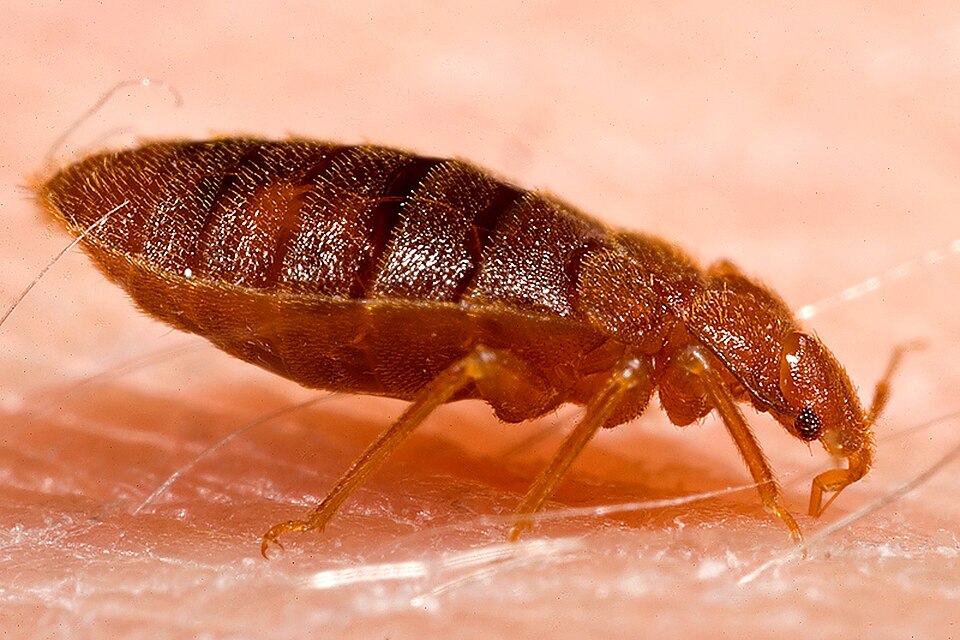
Diagram, enlarged. Real adult: 5–9 mm — about an apple seed. Flat oval, six legs, two antennae, wingless. Turns swollen and purplish-red after feeding.
Egg, nymph, adult
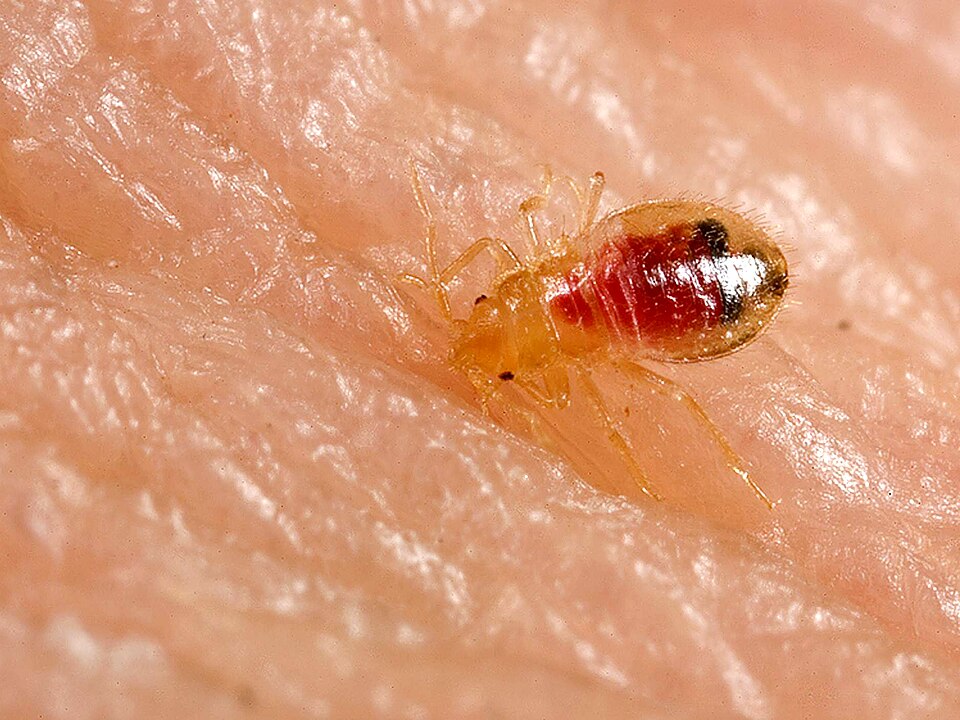
Eggs are tiny (about 1 mm), pearly-white, and glued into cracks in small clusters; they hatch in roughly one to two weeks. What hatches is a nymph, and there are five progressively larger nymph stages — each one must take a blood meal before it can molt to the next. Young nymphs are pale and nearly translucent; they darken toward reddish-brown as they grow. UC IPM · EPA
Relative sizes, drawn to scale with each other. A blood meal is required between every stage — which is why an infestation can’t survive without a host.
The signs — even if you never see a live one
People rarely spot the bug first. They spot what it leaves behind. Check the mattress seams, the box spring, the bed-frame joints, behind the headboard, and any crack near where you sleep — anything wider than a credit card.
On the sheets
Rusty or reddish stains
Small smears from bed bugs that were crushed after feeding. EPA
The clearest sign
Dark fecal dots (•)
Pinpoint dark spots — digested blood — often in clusters along a seam. Touch a damp cloth to one and it smears reddish-brown, “like a marker would.” EPA
Growing up
Pale shed skins
Translucent, straw-colored husks left behind each time a nymph molts. Finding these means bugs are actively developing. EPA
Next generation
Eggs and eggshells
Whitish, about 1 mm, cemented into cracks and seams — usually in clusters, easy to miss without a flashlight. UC IPM
What it’s probably not — the look-alikes
Most “bed bug” panics turn out to be one of these. None of them infest a bed the way a bed bug does, and most don’t bite people at all.
| What it is | Size | The tell | Bites you? | |
|---|---|---|---|---|
| Bed bug | 5–9 mm | Flat oval, reddish-brown, 6 legs, no wings; hides in bedding seams. | Yes | |
| Carpet beetle larva | 4–5 mm | Fuzzy and bristly with light/dark stripes, carrot-shaped — eats fabric, not blood. | No | |
| Flea | 1–3 mm | Tiny, dark, and flattened side-to-side — and it jumps. Bed bugs can’t jump. | Yes | |
| Tick | 3–5 mm | Has eight legs — it’s an arachnid, not an insect. Rounder, and attaches to skin. | Yes (attaches) | |
| Bat bug | 4–6 mm | Nearly identical — separated only under a microscope (longer body hairs). Lives with bats, not beds. | Rarely |
Sources: UC IPM, Penn State Extension, University of Minnesota Extension. Icons are diagrams, not to scale with each other.
Why bites can’t confirm it
It’s tempting to diagnose from a row of itchy welts, but every authority says not to. “Bites should never be used for diagnosis because several household pests are known to bite humans, and bite reactions vary among people.” Some people welt badly; others in the same bed show nothing for weeks. Find the bug or its signs — that is the only confirmation that holds up. UC IPM · UMN Extension
When to bring in an inspector
- You found something but can’t identify it. Seal the specimen in a bag or clear tape and take it to your county extension office or a licensed pest professional — a positive ID decides everything that follows.
- You have the signs but can’t find the bug. A trained inspector — sometimes a canine team — finds what a flashlight misses. Before anyone treats, verify they’re licensed for bed bug work in your state.
- It’s confirmed. Start the plan: what to do tonight, then treatment. If you rent, your state’s page shows who pays.
Where this comes from
- U.S. EPA — How to Find Bed Bugs; Introduction to Bed Bugs. epa.gov/bedbugs
- UC Statewide IPM Program — Bed Bugs Pest Notes (size, stages, look-alikes). ipm.ucanr.edu
- Penn State Extension — Biology, Habitat, and Management of Bed Bugs. extension.psu.edu
- University of Minnesota Extension & U.S. CDC — identification and “bites can’t confirm.” cdc.gov/bed-bugs
Reviewed against these sources on . The figures on this page are original diagrams drawn to published measurements, not photographs. For macro reference photos, the CDC and EPA publish public-domain images.